
While you made love to her,
I wrote this manifesto.
(Parts I & II – The Forgotten & The Forgiven).
I’ve been working on a poetry manuscript called While you made love to her, I wrote this manifesto, an attempt to bring logic and purpose to love, heartbreak, memory, agency, not just as an individual process but as a political act of remembrance and active choice of being present, ensuring the links between past and future, in spite of the emotional vulnerabilities and griefs of a painful process in the present. The willingness of remembering without remaining imprinted by loss, rather choosing a new identity built as a form of survival through the wreckage and, since nothing can be rewritten, towards an informed new existence.
The title makes the narrative of the book self explanatory: Its protagonist abandons the expectations of traditional domestic life and finds belonging within political resistance. There, she becomes involved with someone already committed to another person. United by rebellion, artistic comradeship, and shared ideals, they mistake intensity for liberation. As the relationship unravels, the contradictions between political convictions and private actions become impossible to ignore. Confronting her complicity, the loss of love, and the self she inhabited within it, she writes a manifesto. The fragments with which I work here are parts of the actual manifesto that concludes the poetry book. Herein parts II The Forgotten, and III The Forgiven.
At its center lies the distinction between the Forgotten and the Forgiven. The Forgotten seek refuge in erasure; the Forgiven enter grief willingly, allowing pain to become knowledge. Forgiveness is neither absolution nor the abandonment of accountability, but the possibility of remembering without remaining imprisoned by loss.
My references include Roland Barthes’s punctum, Tina M. Campt’s practice of listening to images, and Ovid’s poem: Gutta Cavat Lapidem (the drop of water hollows out the stone) a reminder of perseverance through all ordeals… but also a well known method of torture, for the repetitive drop can also pierce a skull, or at least drive one to madness, the same as love. The text takes its style/form from The Communist manifesto as I wanted to develop a very radical voice and perspective. It is influenced by the cut-up technique popularized and defined by William Burroughs, and by HC Andersen’s storytelling and melancholy, which in turn deeply influenced Burroughs’ work. Whereas Burroughs carries the crimes and mistakes of his marriage with obsessive regret, HC Andersen was criticized for his inability to even be in a relationship, but instead always pining for whom he could not have.
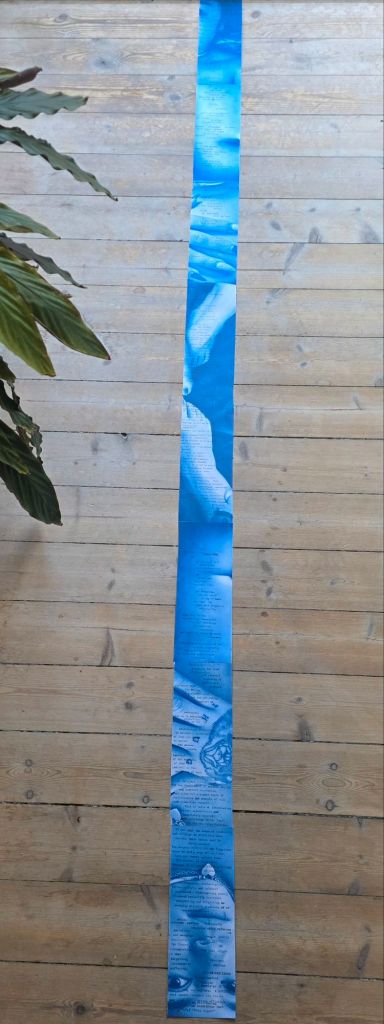
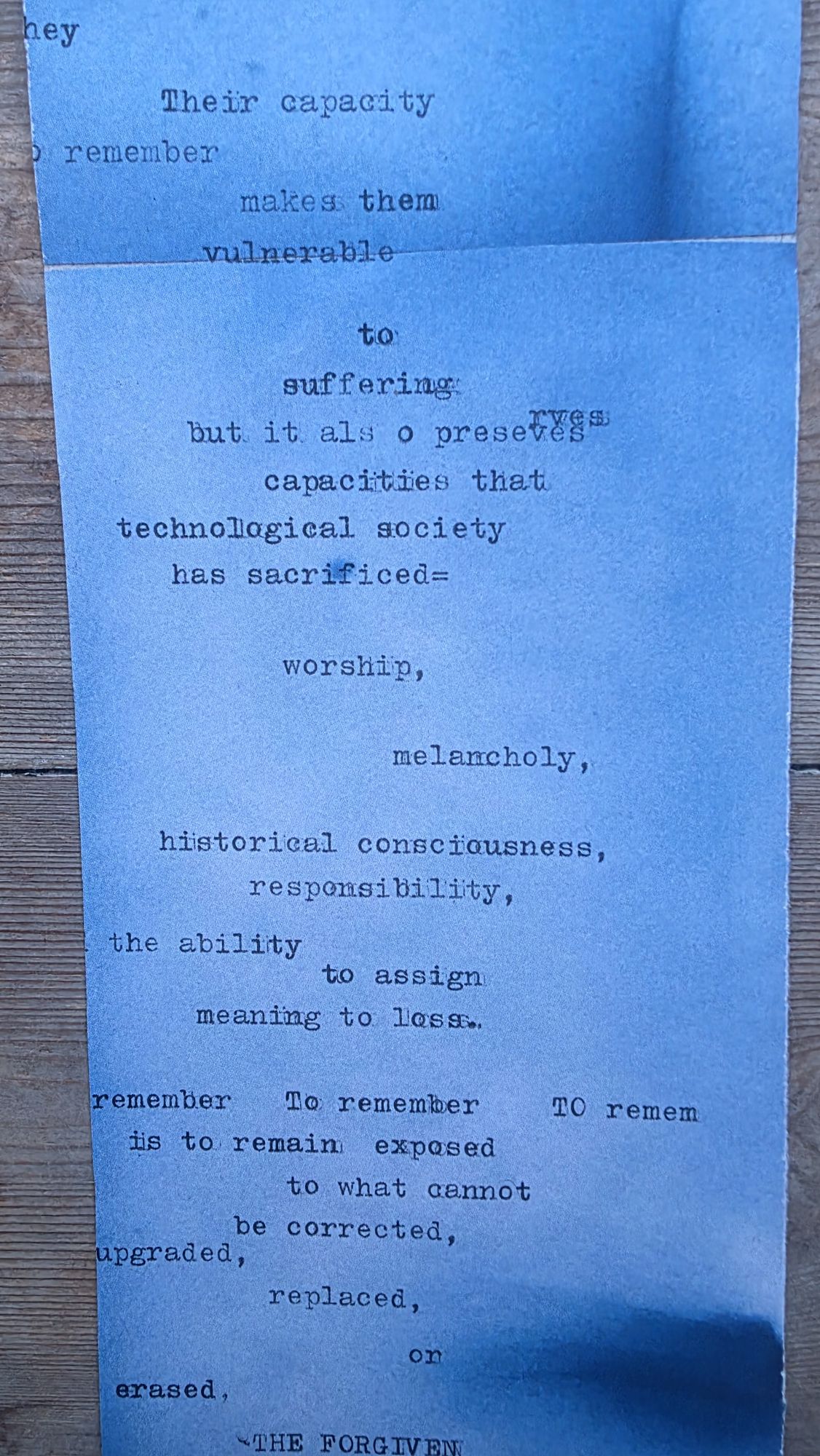
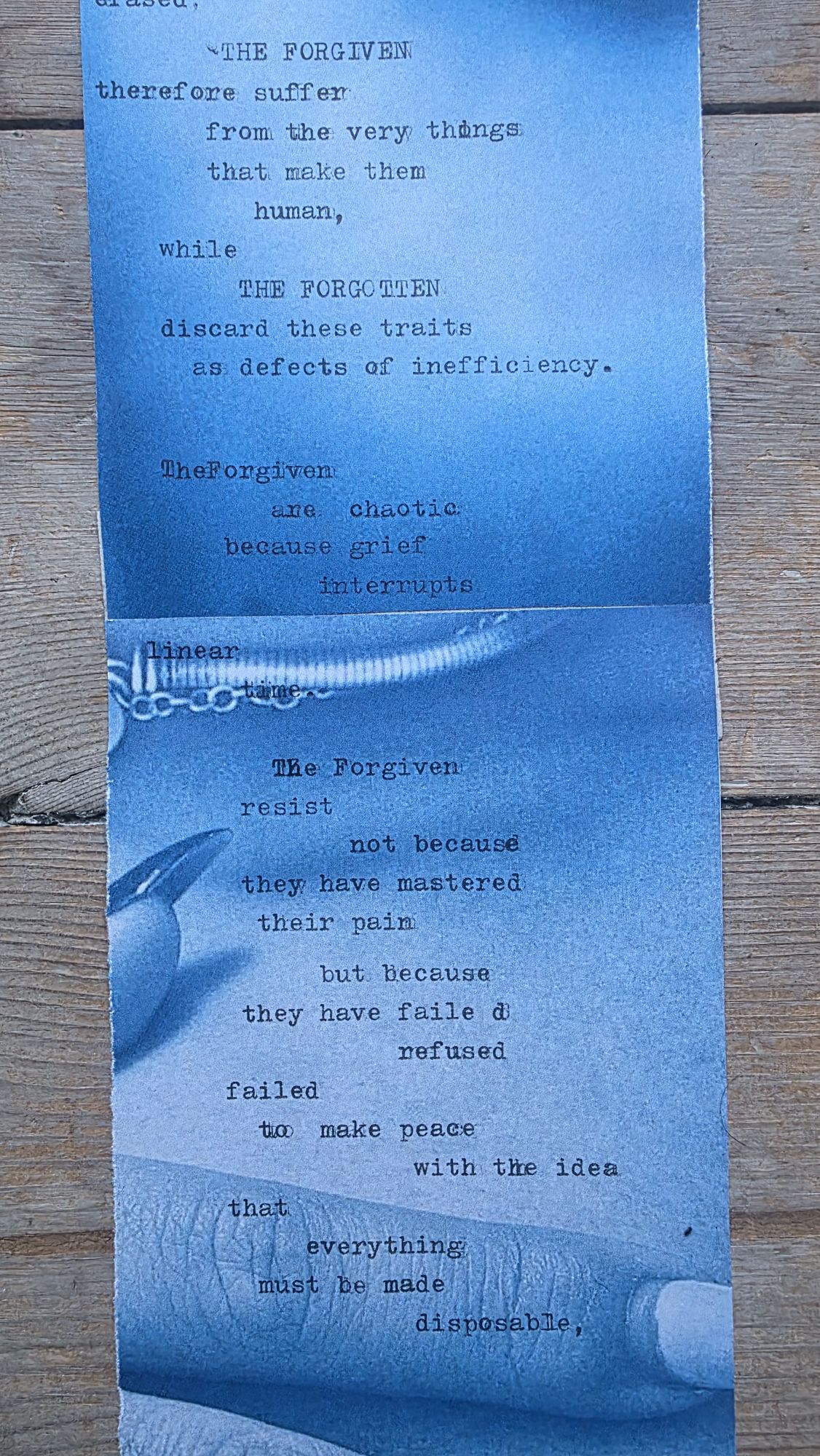
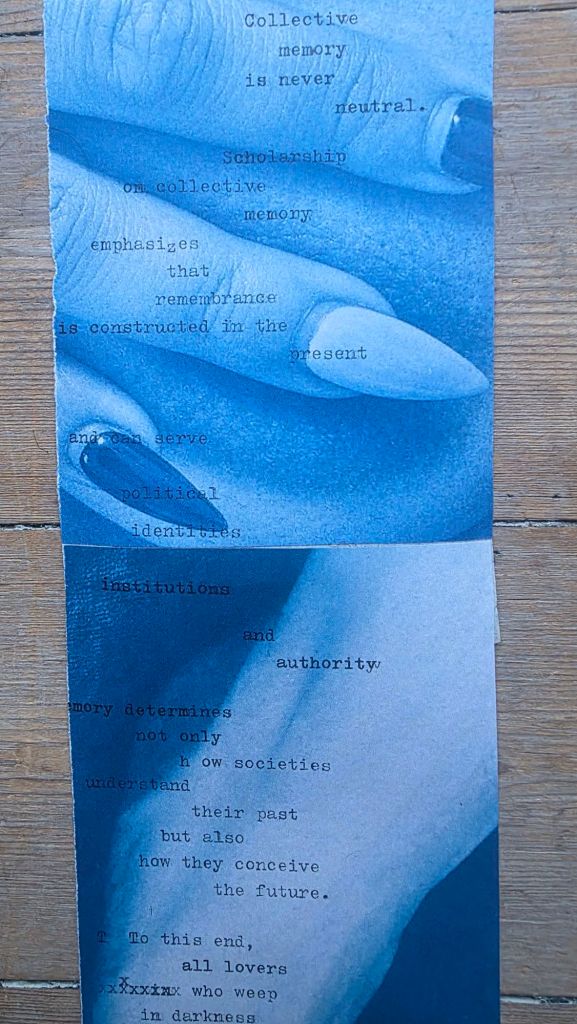
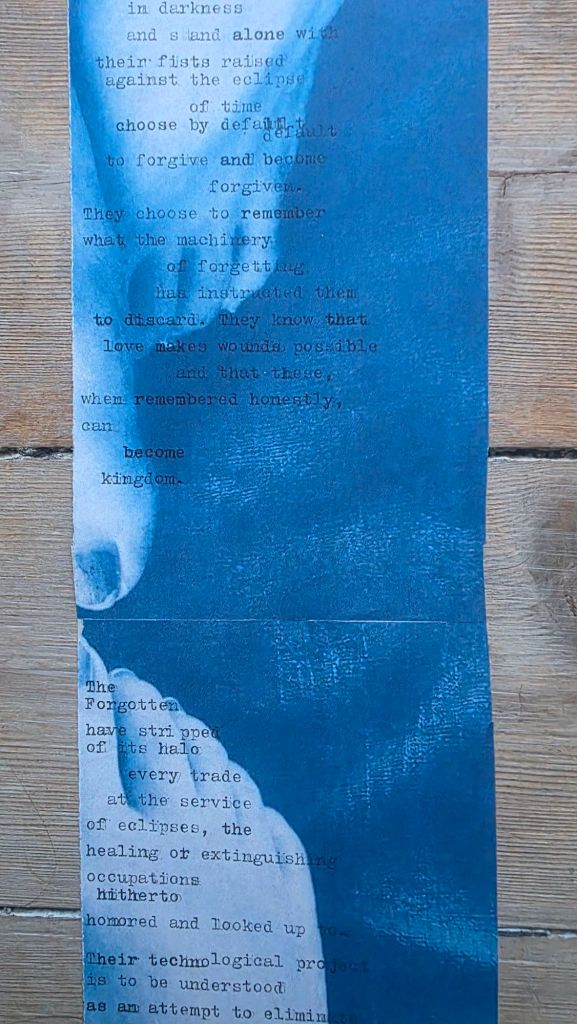
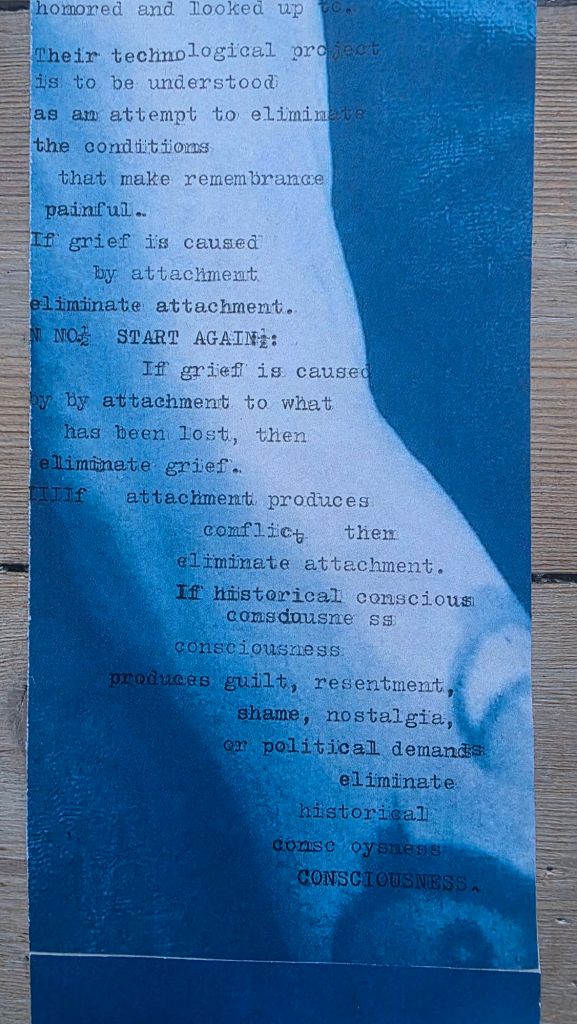
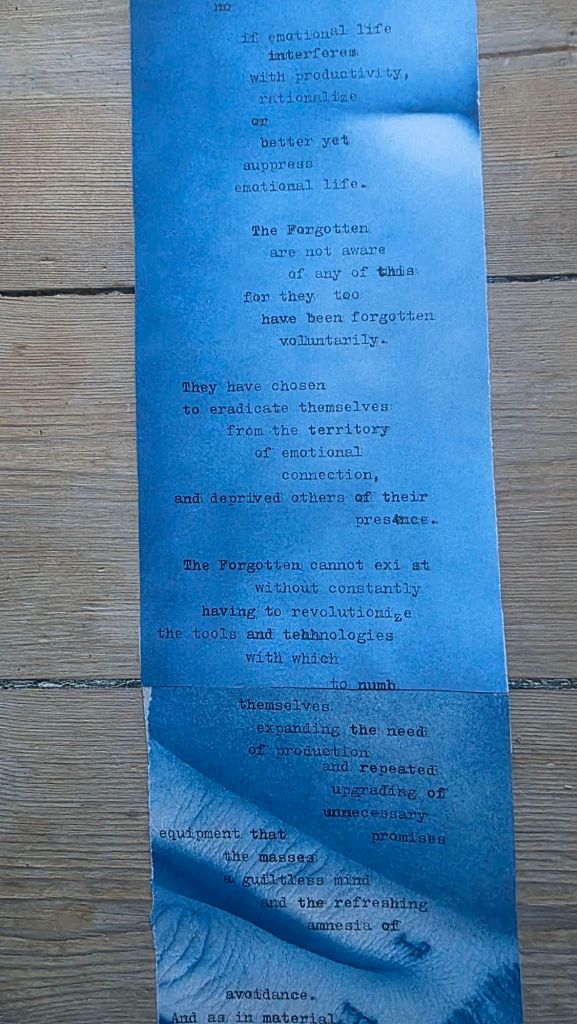
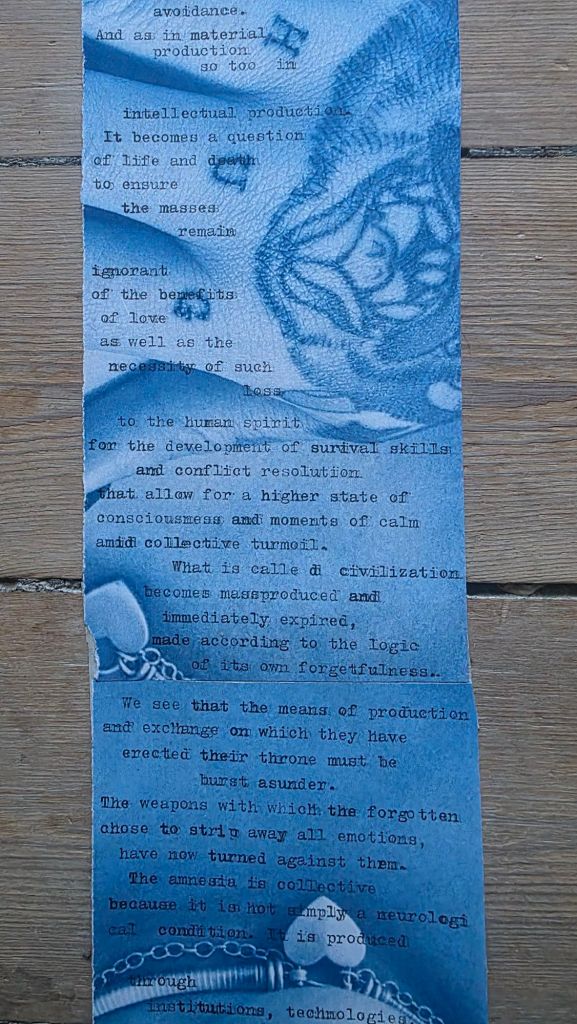
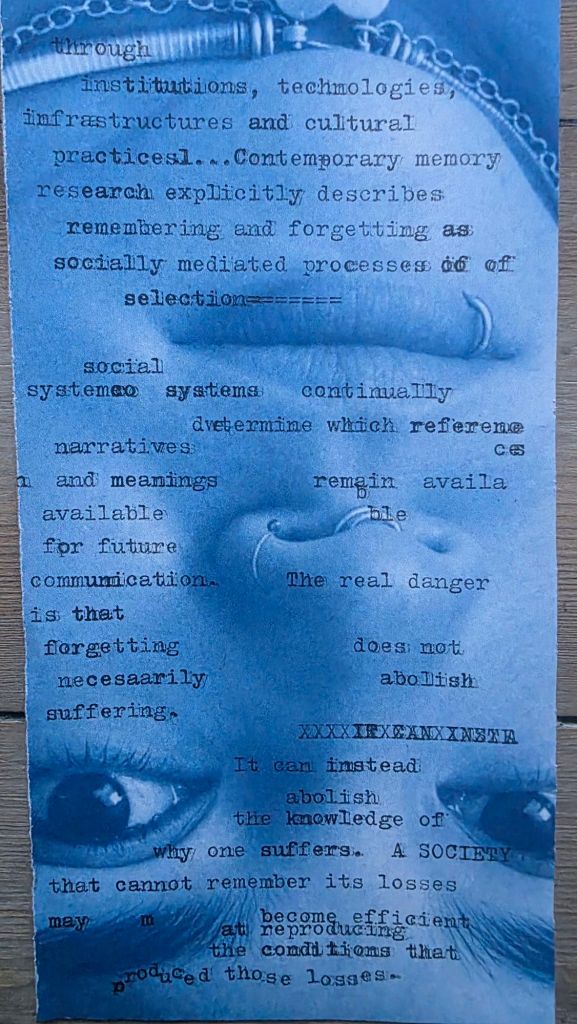
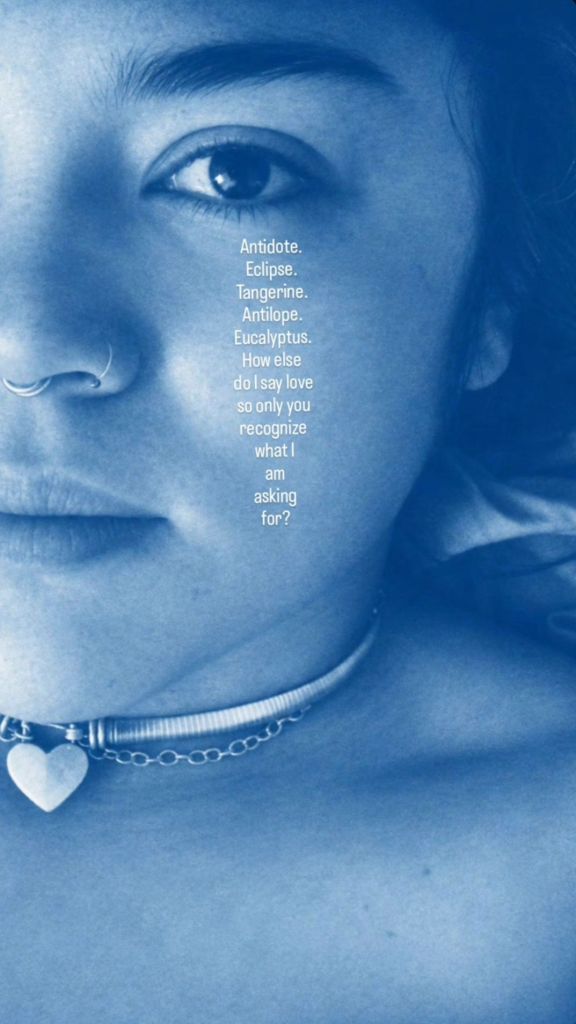
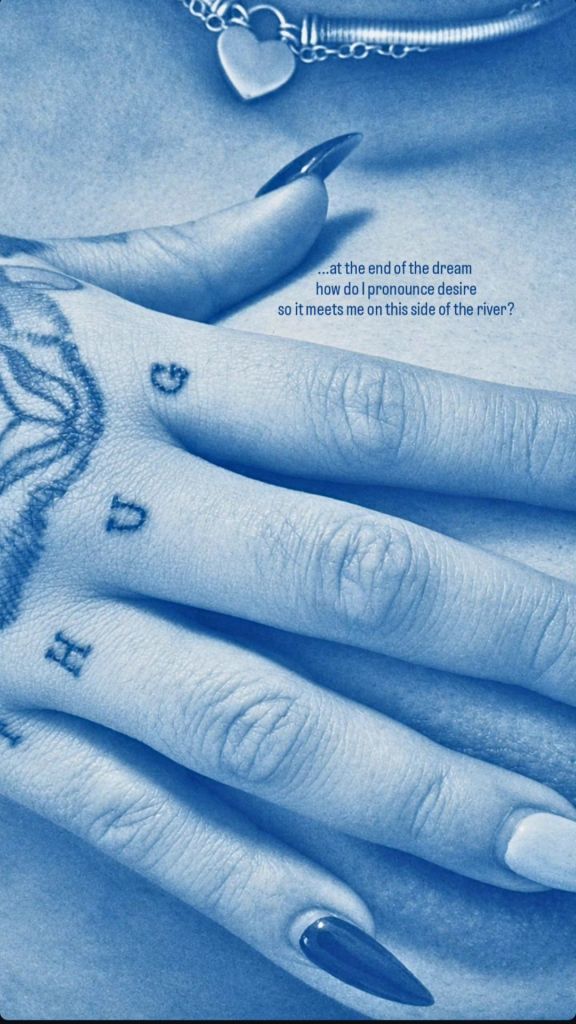
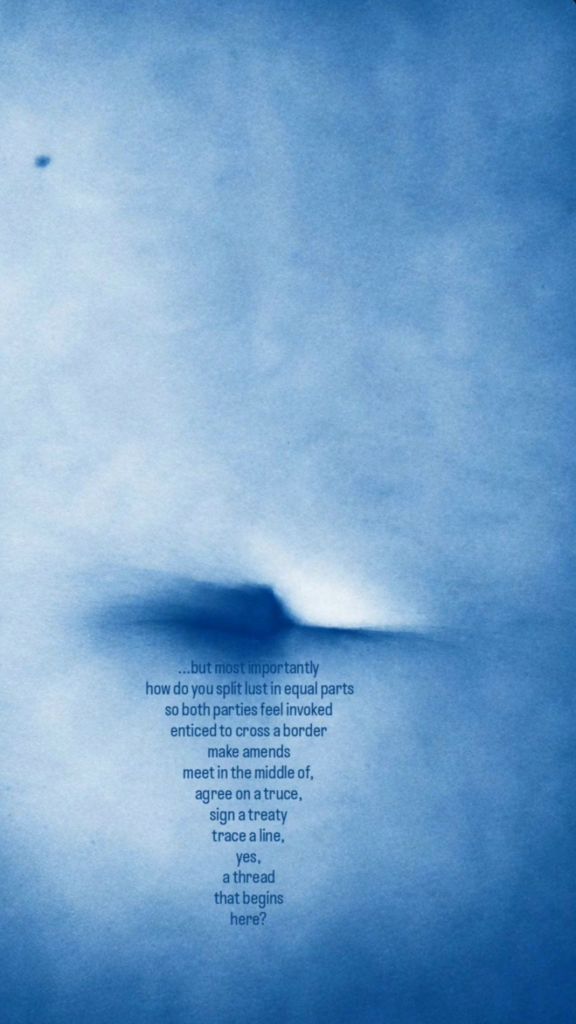
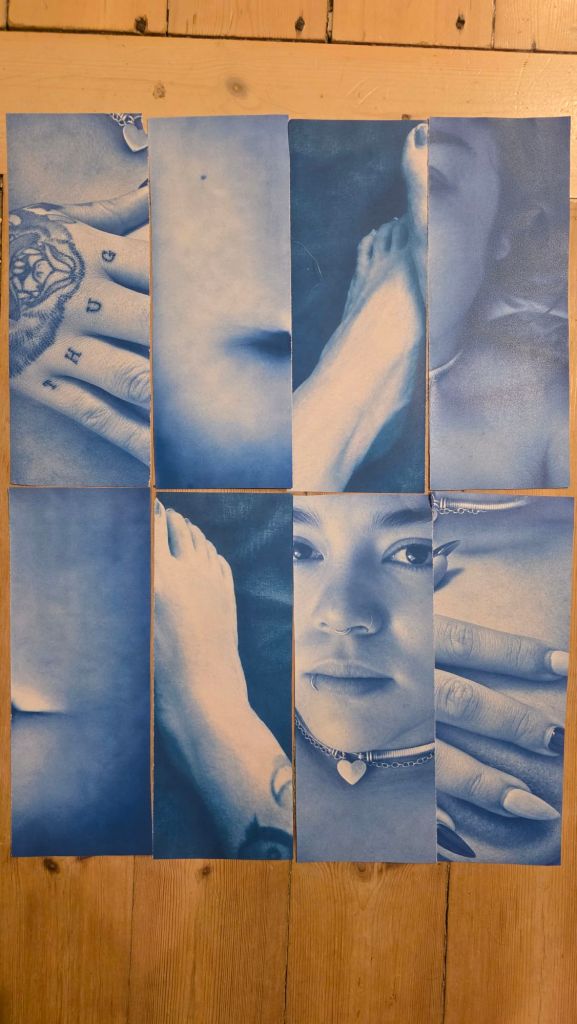
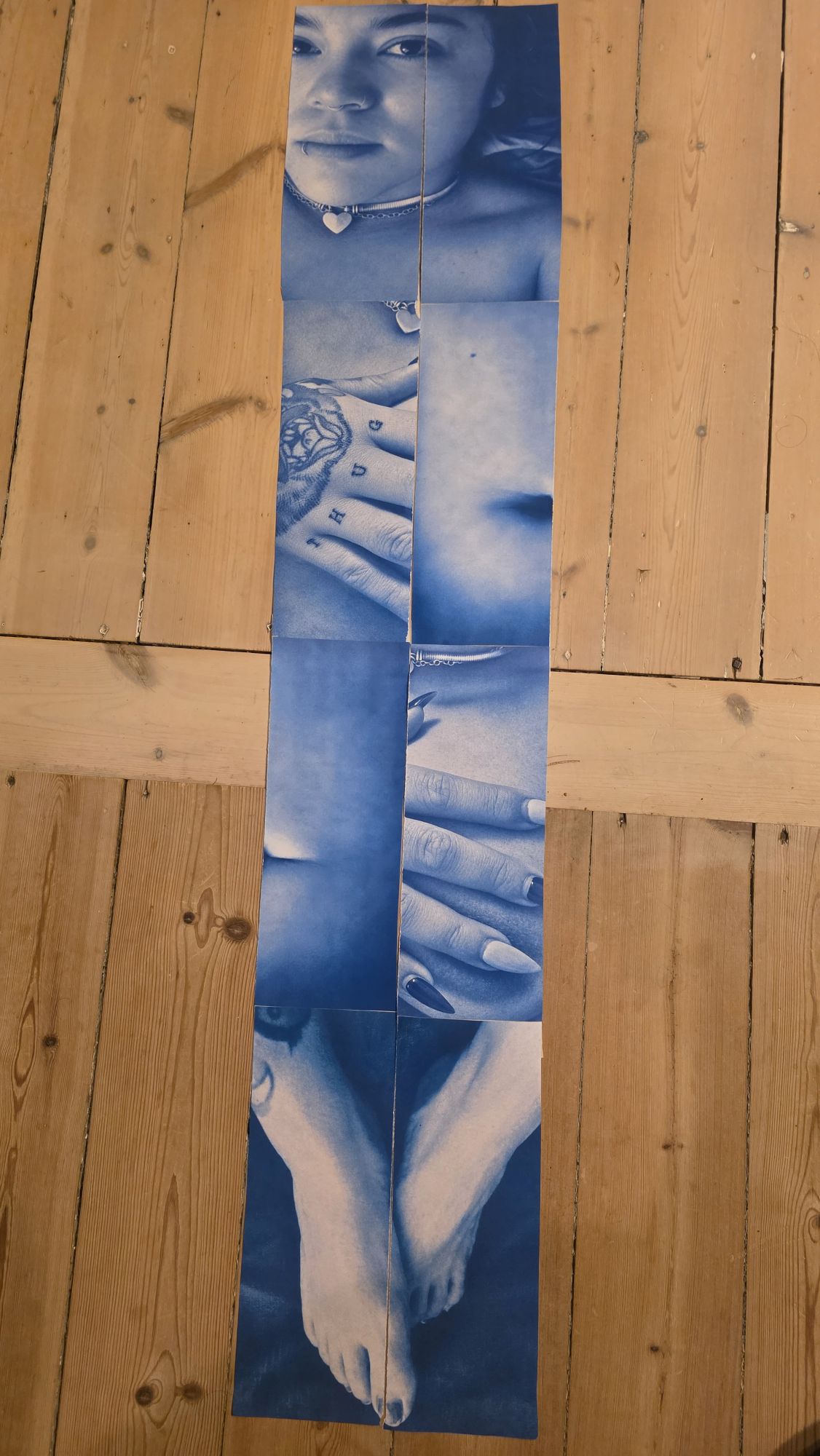
I’ve combined analog and digital processes to create this piece. Through cropping, layering, handwritten interventions, and repetition, I explore how images and words challenge one another. A photograph might contradict a poem, expose what the speaker cannot articulate, or transform an ordinary detail into evidence of loss. What remains outside the frame becomes as significant as what is visible; The photographs of parts of my self, to represent the pieces or parts one keeps of a time, of a body, of a lover, since one never remembers a whole body, be it of flesh or of time, and by default a whole relationship, in a linear format… but through pieces that together form a puzzle, a story, an imprint.
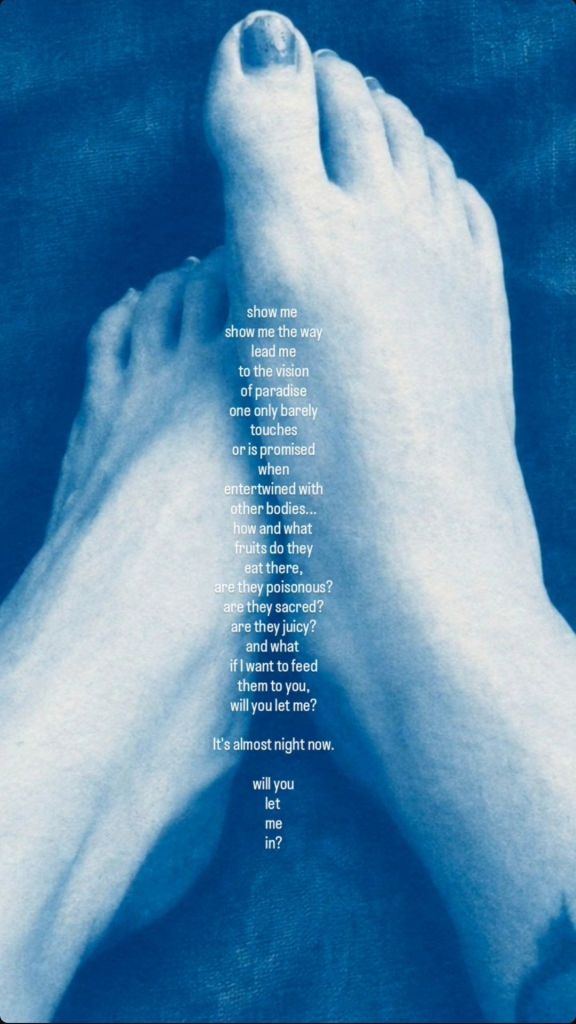
These pieces have been put together to represent the two bodies: The Forgotten and the Forgiven. Their feet are almost touching, a little homage to Michelangelo’s The Creation of Adam, here to represent how love transforms and has the power of construction, destruction and rebirth.
One of the bodies is always upside down, like in the Tarot’s Hanged Man, which often symbolizes voluntary surrender. That is the whole conversation of my manuscript, and especially of this manifesto. How we always have the option to surrender to love and sacrifice our ignorance and superficial contentment by accepting the consequences of carrying what’s left of a relationship, the trauma of the shipwreck, the longing, the inability to take it back, but by doing so, becoming aware of certain truths that make of remembering a political act.
Otherwise, there is always the comforts of oblivion, which I envision as a superficial happiness, a life occupied with simple tasks and frequent upgrades to distract the heart from the reality of all it has lost.
The visual scroll is cut and put together with tape. I am seeking the Forgiven’s perspective. Their view of Heartbreak as an act of resistance, submission, hidden, quiet, courageous, pathetic, unbearably repetitive. The hand-made, improvised, analog feel, the slowness of learning through failing and learning from our experiences, taking the conscious time of penance and slow healing. It is also an homage to the perspective of the victim, the one left behind to carry the abandoned love story, so the act of using a typewriter to write this is also an exercise in patience, a voluntary sacrifice, a display of imperfect beauty… where the option of The Forgotten would have been a quick copy/paste with the aid of artificial intelligence, prepackaged feelings and quick dismissal.
The two videos are also documentation of this camino of letting go. The first one is the reading of the manifesto on the scroll, with the background recordings of the making of the scroll: cutting, arranging, taping together, typing… mending. A hidden detail of this part of the project, is that, out of 20 machines in my collection, I’ve typed this manifesto on my Olivetti Valentine typewriter, a comment on how the Forgiven and Forgotten will never experience another valentine’s day together.
The last video, which concludes this interdisciplinary piece, is a video before the character was split, changed, morphed into a manifesto. The pieces of the body as fragments that tell the story of immediately realizing it is over. A poem, from the perspective of the Forgiven, asking for a way to reconnect the thread, bring the bodies closer, return to the encoded language of the lovers, while becoming aware of the imminent truth.
As the manifesto concludes:
“None of this changes anything. For you have chosen to forget, and I have chosen to forgive you.”
“None of this changes anything. For you have chosen to forget, and I have chosen to forgive you.”
Visual Poetics:
I
The forgotten
The Forgiven, historically, have played a revolutionary role. The Forgotten, in direct opposition,
need not keep tabs on the comings and goings of the heart and have chosen instead the comforts
of mundane entertainment and the body as a vessel of superficial connection; behaviors which
erode the public space and reduce the possibilities of honest, stubborn, delusional failure in the
business of the heart, now at risk of bankruptcy. The Forgotten are not necessarily those who have
lost their memories. They are those whose memories have been made socially unnecessary,
politically inconvenient, economically unproductive, or technologically obsolete.
The Forgotten have stripped of its halo every trade at the service of eclipses, the healing or
extinguishing, occupations hitherto honored and looked up to.
Their technological project is to be understood as an attempt to eliminate the conditions that make
remembrance painful. If grief is caused by attachment to what has been lost, then eliminate grief.
If attachment produces conflict, eliminate attachment. If historical consciousness produces guilt,
resentment, nostalgia or political demands, eliminate historical consciousness.
If emotional life interferes with productivity, rationalize or suppress emotional life.
The Forgotten are not aware of any of this, for they have been forgotten. They have voluntarily
chosen to eradicate themselves from the territory of emotional connection, and deprived others of
their presence.
The Forgotten cannot exist without constantly having to revolutionize the tools and technologies
with which they numb themselves, expanding the need for the production and repeated upgrading
of unnecessary equipment that promises the masses a guiltless mind and the refreshing amnesia of
avoidance. And as in material production, so too in intellectual production. It becomes a question
of life and death to ensure the masses remain ignorant of the benefits of love, as well as the
necessity of such loss to the human spirit, for the development of survival skills and conflict
resolution that allow for a higher state of consciousness and moments of calm amid collective
turmoil. What is called civilization becomes mass-produced and immediately expired, made
according to the logic of its own forgetfulness. We see then that the means of production and
exchange, on which they have erected their enlarged throne, must be burst asunder.
The weapons with which the forgotten chose to strip away all emotions, have now turned against
them. The amnesia is collective because it is not simply a neurological condition. It is produced
through institutions, technologies, infrastructures and cultural practices. Contemporary memory
research explicitly describes remembering and forgetting as socially mediated processes of
selection: social systems continually determine which references, narratives and meanings remain
available for future communication. The danger is that forgetting does not necessarily abolish
suffering. It can instead abolish the knowledge of why one suffers.
A society that cannot remember its losses may become extremely efficient at reproducing the
conditions that produced those losses. It does not merely automate labor; it automates emotional
life. That is the more radical proposition.
To the Forgotten, emotions are inefficient because they produce attachment, hesitation, memory
and obligation. Grief makes a person stop working. Love creates loyalties that may compete with
institutions. Nostalgia challenges the idea that the present is superior to the past. Guilt can interrupt
progress. Mourning creates obligations toward the dead. So, the task is to optimize the human
being by progressively removing whatever cannot be optimized. Eventually, the perfect worker is
the person who has nothing to mourn. Consequently, the main technological achievement of the
Forgotten is not merely the abolition of sadness. It represents an extraordinary concentration of
political power: the power to determine which experiences are permitted to have consequences in
the future. Erasure become blade pointed toward the self.
If a population can no longer remember injustice, then injustice becomes difficult to conceptualize
as injustice. If nobody remembers exploitation, exploitation can appear natural. If nobody
remembers war, peace becomes indistinguishable from historical amnesia. If nobody remembers
a dead person, their absence ceases to constitute a social claim upon the living. The ultimate
achievement is therefore not immortality, but the elimination of historical accountability.
Forgetting is never distributed equally. The dead may disappear from history, but someone remains to inherit the world that their disappearance made possible.
……..
III
The forgiven
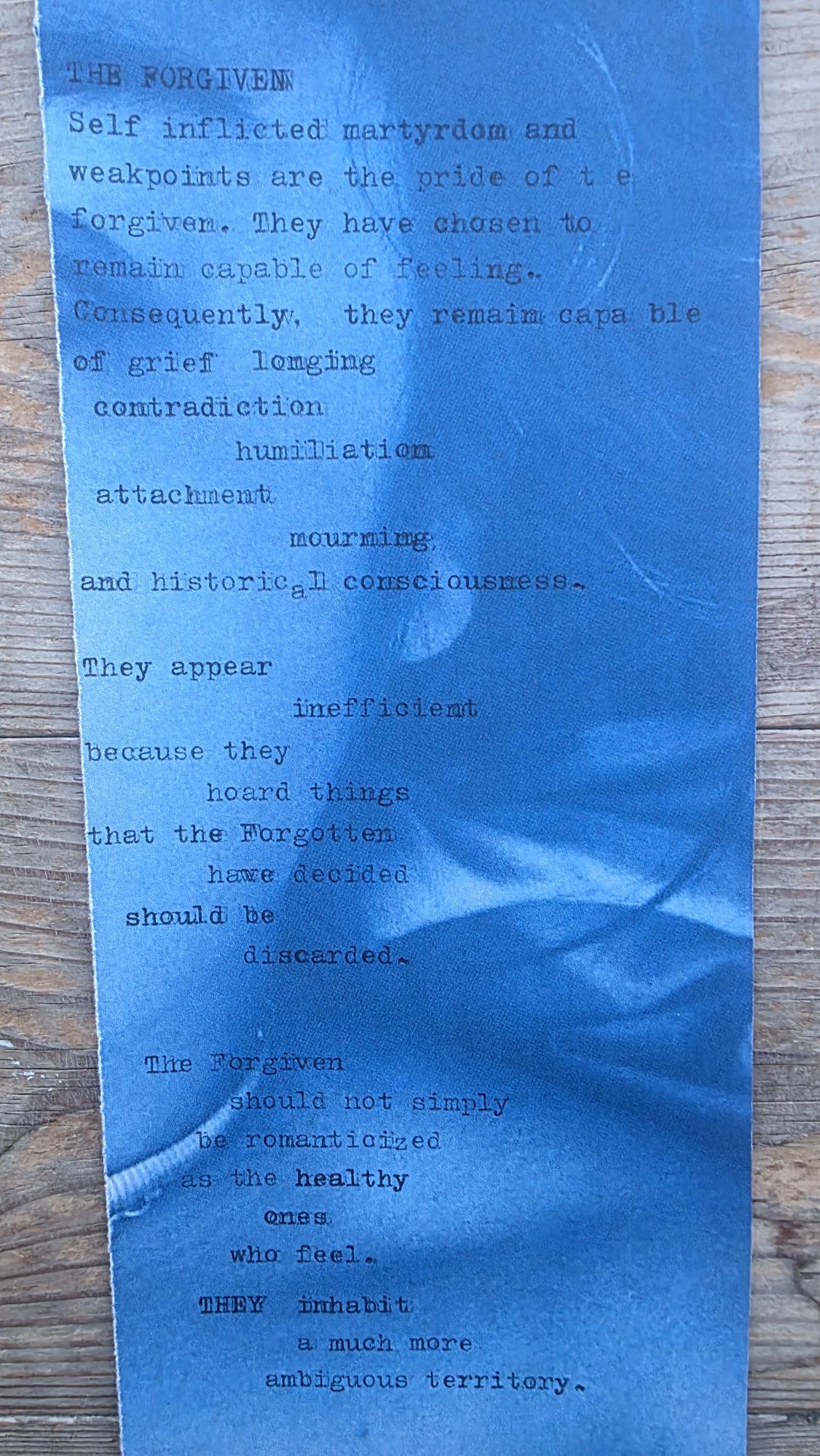
Self-inflicted martyrdom and weak points are the pride of the Forgiven. They have chosen to
remain capable of feeling. Consequently, they remain capable of grief, longing, contradiction,
humiliation, attachment, mourning, and historical consciousness. They appear inefficient because
they hoard things that the Forgotten have decided should have been discarded.
The Forgiven should not simply be romanticized as “the healthy ones who feel.” They inhabit a
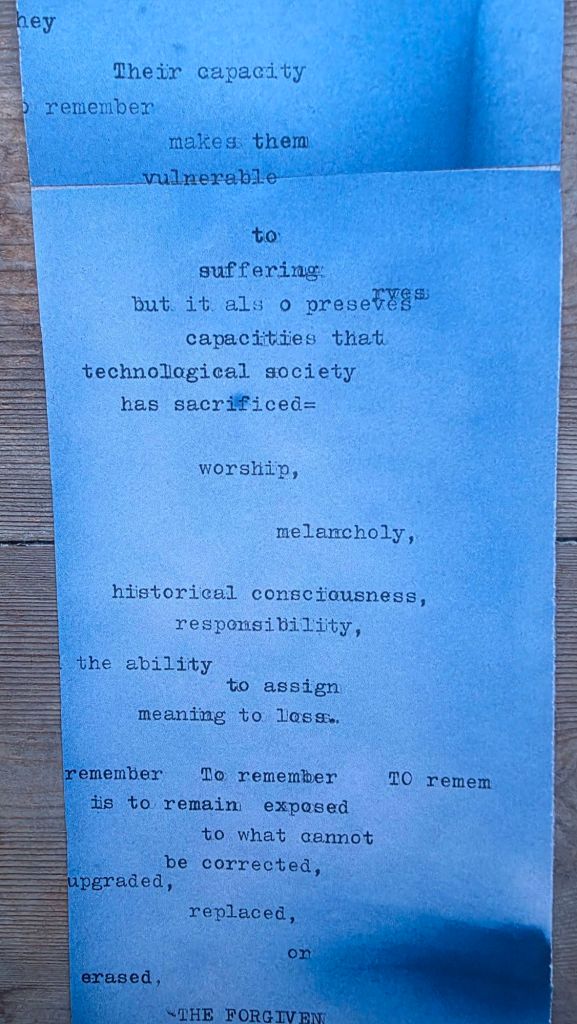
much more ambiguous territory. Their capacity to remember makes them vulnerable to suffering,
but it also preserves capacities that technological society has sacrificed: worship, melancholy,
historical consciousness, responsibility, and the ability to assign meaning to loss. To remember is
to remain exposed to what cannot be corrected, upgraded, replaced, or erased. The Forgiven
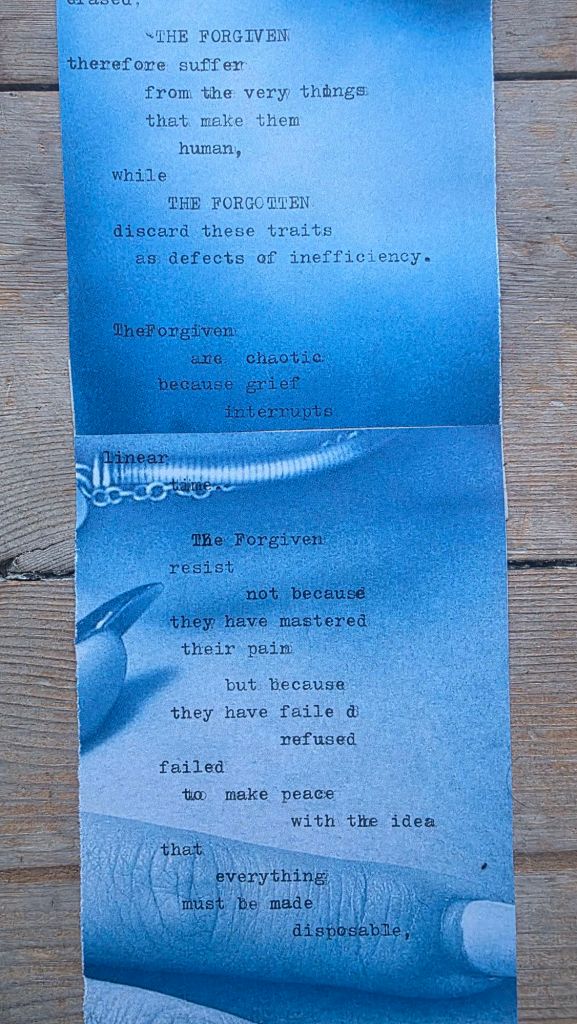
therefore suffer from the very things that make them human, while the Forgotten discard these
traits as defects of inefficiency.
The Forgiven are chaotic because grief interrupts linear time.
The Forgiven resist not because they have mastered their pain, but because they have failed /
refused to make peace with the idea that everything must be made disposable.
Collective memory is never neutral. Scholarship on collective memory emphasizes that
remembrance is constructed in the present and can serve political identities, institutions and
authority. Memory determines not only how societies understand their past but also how they
conceive their future.
To this end, all lovers who weep in darkness and stand alone with their fists raised against the
eclipse of time erasing the remaining traces of love, choose by default, to forgive and become
forgiven. They choose to remember what the machinery of forgetting has instructed them to
discard. They accept the weakness of attachment, the inefficiency of mourning, the humiliation
of longing. They remain exposed to one another. And in doing so, they preserve the possibility
that what has been lost can still mean something. They know that forgiveness does not return us
to what existed before the injury. They know that love makes wounds possible and that these,
when remembered honestly, can become kingdom.
Gutta Cavat Lapidem.


